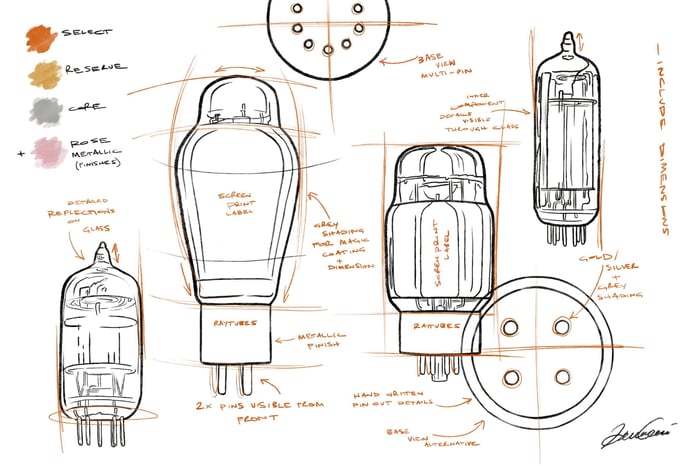


Hand-selecting our tubes is a vital part of our quality control, but it's not for the faint of heart. In each batch of thousands of tubes, only five percent pass our checks, and an even smaller percentage end up as part of a matched set. When I'm introducing our products to interested parties, I spend a lot of time going through this process, because it's foundational to everything else we do. Ray Tubes could not exist without it. It's also long, finicky, and at times downright annoying. Occasionally, the person I'm talking to will raise an interesting question: why is this all necessary? What makes vacuum tubes different from any other mass produced products, which generally don't go through such meticulous quality control?
It's a good question. It gets at some fundamental assumptions about mass production and product quality that are often taken for granted. Over the course of these conversations, I've figured out how best to put my answer into words. That's what this post is.
Vacuum tubes are mass produced electrical components. At first glance, you'd be forgiven for thinking that they ought to all be the same. That's the point of mass production: it standardizes the manufacture of huge quantities of identical items. Hand selection, on the other hand, is a process that's more at home in artisanal contexts, like small-scale pottery. It's hard to control for all variables in a pottery kiln, so each batch varies. Potters hand-select the items that came out great, then recycle the others or sell them at a discount. Why is it that vacuum tube manufacturing, which is very much not small-scale, operates on a similar principle?
The full answer to this question is complex and tied up in the physics and chemistry that makes tubes work, but I'll do my best to give a layperson's summary. In short, tube performance is highly sensitive to small variances in the production process. There's a few reasons for this. First, the electric current through a tube is governed by the Richardson-Dushman equation. This equation is exponential, which means that a small change in, say, cathode temperature has an outsize effect on the current. Second, the electrical characteristics of vacuum tubes are highly sensitive to the spacing of the tube's internal components. A difference of only a few microns has a measurable effect on transconductance, but the manufacturing process is precise to only about twenty microns. Finally, the performance of the cathode depends on trace quantities of elements like silicon, magnesium, and manganese. Too little, and the tube won't work; too much, and it will sound distorted. Once again, consistently achieving the required level of precision is impossible.
The bottom line is that tube manufacturing simply isn't precise enough, and that's especially true for demanding applications like audio. This has always been the case. Back in the day, New Old Stock tubes went through a selection process much like ours do today. Tubes have always been hand-selected because they are, on a fundamental molecular level, extremely finicky devices.
At this point, I sometimes get incredulous looks. Technology has come a long way since the mid-20th century. Can it really be true that tube manufacturing is still plagued by the same issues? It can. Tube manufacturing today is more or less the same as it was back then. The materials may be different—there's fewer toxic chemicals involved, for one—but the machinery is the same. Matching the quality of New Old Stock is hard enough, because the knowledge and experience of that era is slowly being lost as engineers retire and factories are shut down. That's why I'm so proud of what we've achieved at Ray Tubes. Re-invigorating a technology once deemed obsolete is not an easy task, especially one as troublesome as the vacuum tube.
In theory, of course, it would be possible to create new manufacturing processes precise enough to work around the issues I've described. Semiconductor manufacturing is precise to a nanometer scale. But semiconductors underlie almost every aspect of modern technology, and the money spent on developing them rivals the GDPs of whole nations. Perhaps, in a world where the semiconductor was never invented, tube production would have reached those same heights of precision. In reality, the economics don't work.
To sum up: in the manufacture of vacuum tubes, both the science and the economics are stacked against us. The lack of precision is a fundamental flaw that can't be fixed without astronomical amounts of money, hence our use of hand-selection instead.
That's a valid way of looking at it, but before I wrap up, please humor me with an alternate interpretation. Maybe, just maybe, that flaw is the whole point of tube audio. The reason we're in the middle of a tube resurgence is because enough people found the precision of solid state audio cold and impersonal. Like the single flawed brushstroke in a masterpiece, the eccentricities of tube audio are what make it relatable. In a world increasingly at the whims of machines, it's no wonder that we instinctively perceive hand selection as a good thing. A human hand has touched each of our tubes and deemed it suitable for your amp. That's the wonder and the gift of tube audio. Enjoy!